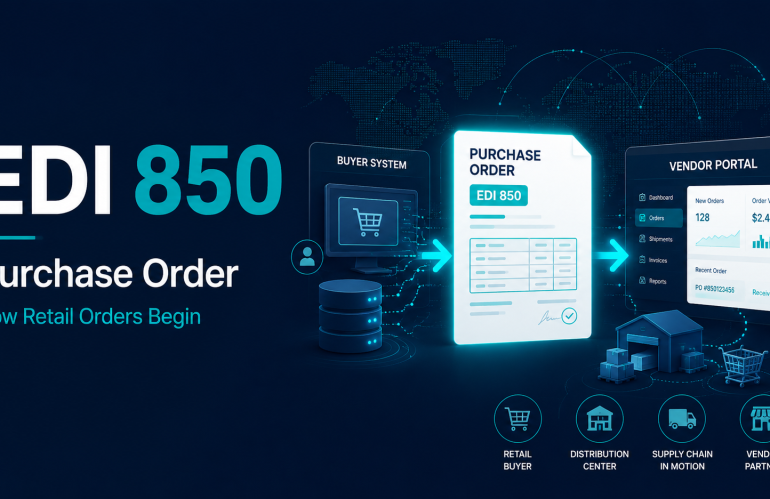
An EDI 850 is the X12 Purchase Order transaction set. A buyer uses it to place an order for goods or services in an electronic data interchange environment. X12 says the 850 is for purchase-order placement—not purchase-order changes or acknowledgments.
What is an EDI 850?
The EDI 850 gives two trading partners a structured way to exchange purchase-order data. In a typical workflow, a buyer’s purchasing or commerce system produces the business data, an EDI process maps it to the partner’s agreed X12 implementation, and the seller’s receiving process validates and imports the order.
The transaction-set number identifies the business document, but it does not eliminate partner-specific rules. Before implementation, both parties still need to agree on the X12 version, required elements, code values, identifiers, transport method, acknowledgment behavior, testing cases, and exception process.
Where the EDI 850 fits in order-to-cash
- EDI 850 Purchase Order: the buyer places an order.
- EDI 855 Purchase Order Acknowledgment: the seller acknowledges the buyer’s purchase order.
- EDI 856 Ship Notice/Manifest: the sender describes shipment contents and configuration, along with related shipment information.
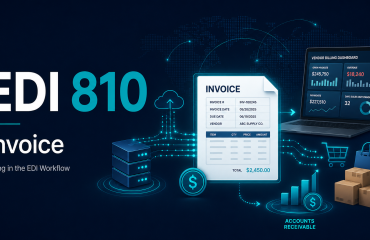
- EDI 810 Invoice: the seller bills for goods or services.
- EDI 820 Payment Order/Remittance Advice: the payer can send payment instructions, remittance detail, or both.
This sequence is a useful model, not a universal mandate. A trading-partner agreement may use additional documents, omit some documents, or define a different timing and acknowledgment pattern.
Common EDI 850 business data
An implementation commonly needs enough information to identify the parties and order, describe requested items and quantities, communicate dates and locations, and carry commercial references. The exact fields and codes must come from the selected X12 version and the receiving partner’s implementation guide.
- Purchase-order number and order date
- Buyer, seller, ship-to, and bill-to identifiers
- Line-item identifiers, quantities, and units of measure
- Requested shipping or delivery dates
- Prices, terms, references, and special instructions when required
EDI 850 implementation checklist
1. Pin the standard and partner guide
Record the exact X12 version and the partner’s current implementation guide. Do not assume that an EDI 850 accepted by one partner will satisfy another partner’s requirements.
2. Define system-of-record ownership
Decide which internal system owns order numbers, customer and location identifiers, item cross-references, prices, dates, and order status. Document how corrections flow back to that system.
3. Build explicit mapping rules
For every required partner field, identify the source field, transformation, code list, default behavior, validation rule, and error owner. Treat unit-of-measure and item-identifier translation as business rules, not formatting details.
4. Test business scenarios
- A normal multi-line order
- An unknown item or location identifier
- A duplicate purchase-order number
- Invalid quantity, date, or unit-of-measure data
- A rejected interchange or transaction
- A valid order that fails during application import
5. Separate acknowledgments from business acceptance
A syntax acknowledgment and a purchase-order acknowledgment answer different questions. X12 describes the 997 as reporting syntactical analysis, while the 855 is the seller’s acknowledgment of the buyer’s purchase order. Design monitoring so teams can distinguish transmission, syntax, application, and business-status failures.
Operational questions to answer before go-live
- How quickly must an incoming EDI 850 be visible in the order system?
- What makes an order a duplicate, and who can release or correct it?
- Which failures trigger an automated alert?
- Who owns item, customer, and location cross-reference maintenance?
- How are partner-guide changes reviewed, tested, and deployed?
- Which order and acknowledgment records are retained for support and audit needs?
A practical EDI 850 foundation
A reliable EDI 850 process starts with a precise partner agreement, explicit mappings, scenario-based testing, and monitoring that follows the order into the receiving application. The goal is not merely to accept a valid file; it is to create an order that the business can fulfill and trace.
If you are planning an ecommerce or order-integration workflow and want to discuss the system boundaries, mapping requirements, and operational checks, contact Neutron Development.
Sources
- X12 Transaction Sets, accessed July 11, 2026.
- X12 855, accessed July 11, 2026.