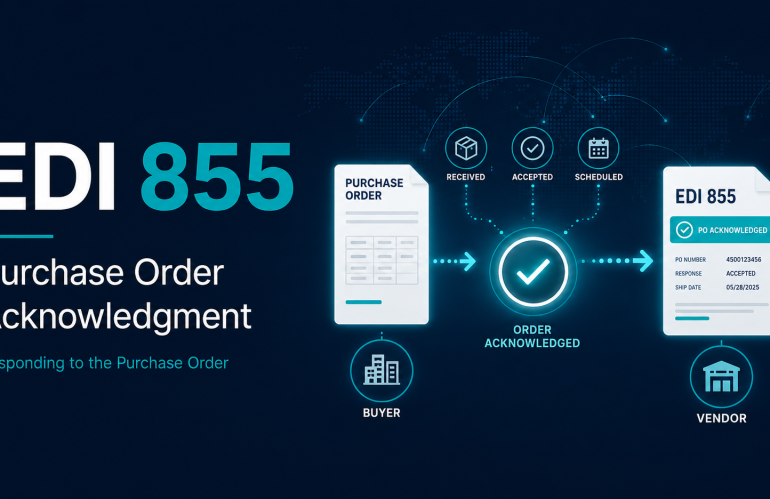
An EDI 855 Purchase Order Acknowledgment is the X12 transaction set a seller can use to respond to a buyer’s purchase order. It helps the parties distinguish between receiving an order and agreeing to fulfill it under the reported terms.
People searching for “EDI 855” are often trying to answer a practical question: did the supplier accept the order, reject it, or propose changes? This guide explains that business role without treating any generic example as a substitute for a trading partner’s implementation guide.
What is an EDI 855?
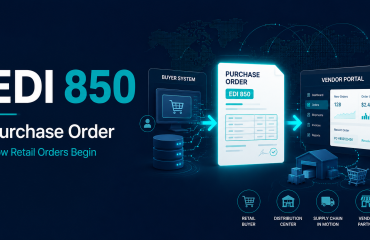
X12 identifies transaction set 855 as the Purchase Order Acknowledgment. It can be used by a seller to acknowledge a buyer’s purchase order. In a typical order flow, the buyer sends an EDI 850 Purchase Order and the seller returns an EDI 855 with its response.
The EDI 855 is a business acknowledgment. It should not be confused with a technical interchange or functional acknowledgment, which addresses whether an EDI transmission was received or structurally processed. An 855 communicates the seller’s response to the purchase order itself.
What does an EDI 855 communicate?
The exact content depends on the X12 version and the buyer’s implementation guide. At a business level, an acknowledgment may communicate an order-level response and line-level details such as accepted items, rejected items, quantity or date changes, and identifying references. Do not assume that every partner uses the same codes, loops, qualifiers, or response rules.
- Order identity: enough information to associate the response with the correct purchase order.
- Acknowledgment status: the response expected by that trading partner’s guide.
- Line references: buyer and supplier item identifiers where required.
- Quantity and timing: accepted values or proposed changes when the guide supports them.
- Exceptions: rejected or changed lines expressed with the partner-approved codes.
EDI 850 vs. EDI 855
| Transaction set | Typical sender | Business purpose |
|---|---|---|
| EDI 850 | Buyer | Communicates a purchase order |
| EDI 855 | Seller | Communicates the seller’s response to that purchase order |
An accepted transport message does not by itself mean the supplier accepted the commercial order. Teams should model technical receipt and business acknowledgment as separate states so an order is not mistakenly treated as confirmed.
A practical EDI 855 workflow
- The buyer creates and sends an EDI 850 Purchase Order.
- The seller’s EDI system validates and routes the order into the appropriate business workflow.
- The seller determines its response using inventory, fulfillment, pricing, and partner rules.
- The seller creates an EDI 855 that follows the buyer’s versioned implementation guide.
- The buyer matches the acknowledgment to the original order and evaluates changes or exceptions.
- Operational teams investigate unmatched, late, rejected, or changed acknowledgments according to agreed procedures.
EDI 855 implementation checklist
- Obtain the current trading-partner implementation guide and confirm its X12 version.
- Document which order-level and line-level responses the partner permits.
- Map purchase-order and line identifiers without losing leading zeros or partner-specific formatting.
- Define how quantity, price, item, and requested-date differences enter an exception workflow.
- Test full acceptance, full rejection, partial acceptance, changed lines, duplicate messages, and unmatched orders.
- Keep technical acknowledgments separate from the EDI 855 business response.
- Monitor acknowledgments that are missing, late, invalid, or impossible to match.
- Retest mappings when the partner revises its guide or changes the required version.
Why partner-specific rules matter
An EDI transaction-set number describes a standard business message, not a universal plug-and-play mapping. Implementers must validate the actual partner guide rather than copy a generic sample.
Common EDI 855 questions
Does an EDI 855 confirm that an order was received?
It communicates a business response to a purchase order. Technical receipt and business acceptance should still be represented separately.
Can an EDI 855 report changes?
It can support acknowledgment information at the order and item level, but the permitted change scenarios and codes depend on the applicable partner guide and X12 version.
Is every EDI 855 mapping the same?
No. Partner requirements can differ in version, required data, code usage, timing, and exception handling. Treat the current implementation guide as the contract for testing.
Build acknowledgment handling around business exceptions
The value of an EDI 855 is not merely that a file arrived. A useful implementation connects each acknowledgment to the original order, makes proposed changes visible, and routes exceptions to the people who can resolve them. If you are planning an ecommerce or order-integration workflow, contact Neutron Development to discuss the operational requirements.