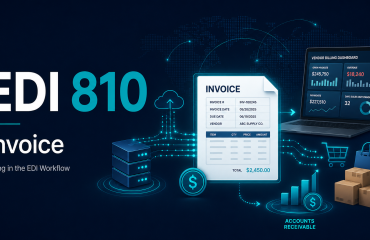
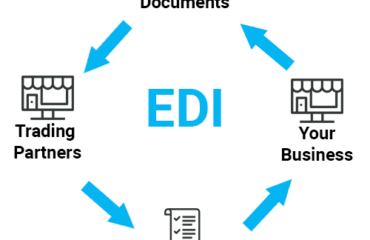
Is EDI being replaced by APIs? Current standards work suggests a more practical answer: established EDI transaction sets are remaining in place while organizations make their data easier to use through JSON and application programming interfaces (APIs).
That distinction matters for ecommerce and supply-chain teams. An EDI 850 purchase order, EDI 856 advance ship notice, or EDI 810 invoice is not merely a file format. Each document represents an agreed business process between trading partners. Modernization succeeds when it improves how those processes connect to internal systems without silently changing their meaning.
What is changing in EDI in 2026?
The clearest current development is convergence. In a December 2025 announcement, standards organization X12 reported that many respondents to its JSON survey were already using X12-based metadata in JSON messages. X12 also said respondents expected to expand JSON use and saw value in standard JSON schemas derived from X12 metadata.
The same announcement provides an important counterweight to “EDI is dead” predictions: respondents said their existing data exchanges remained solidly supported by X12 transactions. The opportunity described by X12 is an easier path to API integrations that retain mature, shared transaction definitions.
EDI and APIs solve different parts of the integration problem
Traditional EDI is strong where trading partners need repeatable document structures, validation rules, acknowledgments, and stable operating agreements. APIs are often useful where an application needs a direct request-and-response interaction, such as checking inventory or retrieving an order status.
A hybrid design can use both. A retailer might receive an EDI 850 purchase order, map it into a canonical internal order model, expose selected order details to an application through an API, and later generate an EDI 856 shipment notice for the trading partner. JSON can be an internal or external representation, but the business rules still need a documented owner and version.
Why standard JSON schemas matter
JSON is easy for many modern applications to produce and consume, but syntax alone does not create interoperability. Two partners can both send valid JSON while using different field names, code lists, required elements, or interpretations of an order.
X12’s work is relevant because it aims to carry standardized metadata into JSON-based exchanges. That can give API developers a common semantic starting point instead of requiring every trading relationship to invent a separate order or shipment model. It does not eliminate mapping or partner-specific requirements, but it can make those differences more explicit.
EDI modernization priorities for ecommerce teams
- Document the business flow before changing the transport. Map the sequence from EDI 850 purchase order through acknowledgments, fulfillment, EDI 856 shipment notice, and EDI 810 invoice. Record which system owns each status.
- Create a canonical data model. Define stable internal meanings for order numbers, item identifiers, quantities, dates, locations, and status codes. Map EDI and API representations to that model rather than connecting every endpoint directly to every partner format.
- Keep partner rules versioned. An X12 transaction set does not remove trading-partner implementation requirements. Store mapping rules, code lists, test cases, and effective dates together.
- Design acknowledgments and exceptions. Decide how technical acceptance, business acceptance, duplicate documents, late messages, and rejected data will be detected and routed.
- Measure the workflow. Useful operational measures include document success rate, exception rate, acknowledgment latency, order-to-ship cycle time, and the age of unresolved failures. Define the source system and time window for every metric.
- Apply security and governance end to end. Protect credentials, limit access, log changes, validate payloads, and avoid placing sensitive trading-partner data in development or AI tools without an approved data-handling process.
AI is an assistant, not the source of truth
Several 2026 vendor outlooks highlight AI-assisted mapping, exception handling, and analysis of EDI histories. These are plausible uses, but they should be evaluated as product capabilities rather than assumed outcomes. A generated mapping still needs validation against the applicable X12 version, partner guide, sample documents, and expected business behavior.
A safe pilot starts with low-risk historical examples, measurable acceptance criteria, and human review. Compare the assisted process with the existing baseline: mapping time, escaped defects, false alerts, and support effort. Do not let an AI system silently modify production mappings or expose confidential transaction data.
Current EDI standards still support new requirements
EDI is also evolving through industry guidance, not only through new syntax. GS1 US released version 2.0 of its EDI recommendations for FSMA 204 critical tracking events in March 2026. The guidance uses the X12 EDI 856 Ship Notice/Manifest in a current food-traceability context. This is a concrete example of an established transaction set being adapted to an emerging operational requirement.
The practical takeaway
In 2026, the useful question is not “EDI or API?” It is “Which shared business definition, representation, and transport fit each step of this trading-partner workflow?” X12 transactions can remain the external contract, JSON can support a modern internal model, and APIs can provide targeted real-time interactions.
Start with one document flow, preserve the partner contract, and improve observability before expanding. If your ecommerce integration needs careful planning across orders, fulfillment, and back-office systems, contact Neutron Development to discuss the workflow.
Sources
- X12’s JSON Survey Validates Consensus-driven Transaction Standards are Critical, X12, December 16, 2025.
- GS1 US EDI Recommendations for FSMA 204 Critical Tracking Events, Release 2.0, March 2026.
- EDI trends in 2026, OpenText, publication date not shown in fetched copy.
- 2026 EDI Trends: What IT Leaders Should Be Watching Now, Remedi, publication date not shown in fetched copy.