The EDI 820 Payment Order/Remittance Advice is an X12 transaction set used to communicate payment-order information, remittance details, or both. In an order-to-cash process, it can help a supplier understand which invoices, adjustments, or other references a customer associates with a payment.
An EDI 820 is especially useful when one payment covers several invoices. Instead of asking an accounts-receivable team to interpret an email, spreadsheet, check stub, or bank narrative, structured remittance data can be routed into a financial system for validation and cash application.
What is an EDI 820?
X12 identifies the 820 as the Payment Order/Remittance Advice transaction set. Its scope allows it to carry payment-order information, remittance advice, or both. The business use depends on the trading-partner agreement and the implementation guide in force.
In practical terms, an EDI 820 can answer questions such as:
- Who is sending the remittance information?
- Who should receive or apply the payment?
- What payment amount and date are being communicated?
- Which invoices or other references are included?
- Are discounts, deductions, adjustments, or unapplied amounts represented?
- Does the message request payment movement, describe remittance, or combine both functions?
Where EDI 820 fits in order-to-cash
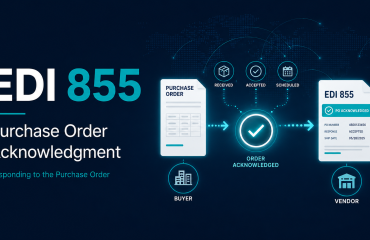
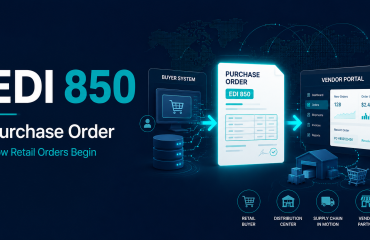
The 820 typically appears near the end of the order-to-cash document flow. A simplified sequence may include an EDI 850 Purchase Order, an EDI 855 Purchase Order Acknowledgment, an EDI 856 Advance Ship Notice, and an EDI 810 Invoice. The EDI 820 then supplies payment or remittance information that can support reconciliation of the customer account.
This sequence is not universal. A retailer, distributor, manufacturer, bank, or payment provider may assign different responsibilities to each party. Some partners send remittance information separately from the funds transfer. Others use an 820 in a payment-order workflow. The applicable partner guide—not the transaction-set number by itself—defines the required structure and business meaning.
EDI 820 versus payment settlement
An important operational distinction is that receiving a valid EDI 820 does not, by itself, prove that money has settled. The message may provide remittance instructions or references, while the actual movement of funds occurs through a banking or payment network. Accounts-receivable automation should therefore reconcile the EDI message with trusted settlement evidence before treating an invoice as paid.
A safe workflow uses separate states for “remittance received,” “payment matched,” and “funds settled.” This reduces the risk of closing receivables merely because a syntactically valid document arrived.
Common information in an EDI 820
The exact segments and qualifiers vary by X12 version and partner guide. An implementation commonly needs to interpret several categories of information:
- Transaction purpose and payment handling: indicators describing what the document is intended to do.
- Payment amount and timing: the amount being reported or ordered and relevant dates.
- Party identification: payer, payee, financial institution, or other identified parties.
- Reference information: invoice numbers, purchase-order numbers, account identifiers, or other matching keys.
- Remittance detail: amounts assigned to individual invoices or referenced items.
- Adjustments: discounts, deductions, allowances, chargebacks, or other differences that require defined reason handling.
Do not assume that a familiar-looking qualifier means the same thing in every implementation. IBM’s support documentation for the RMR segment illustrates that invoice-reference interpretation depends on the associated qualifier. Mapping logic should preserve both the value and its qualifier rather than storing an untyped reference string.
EDI 820 implementation checklist
1. Confirm the exact partner guide
Record the X12 version, release, partner guide revision, required segments, accepted qualifiers, envelope rules, testing process, and production cutover criteria. A public example, including a partner-specific guide in a portal, is useful for understanding the document but is not normative for a different relationship.
2. Define matching precedence
Specify which identifiers can match an open receivable and in what order. For example, the process might consider customer account, invoice reference and amount together. Define what happens when a reference is missing, duplicated, already paid, or associated with a different customer.
3. Model partial and combined payments
Test one payment applied to many invoices, partial payment of one invoice, overpayment, underpayment, credit balance, zero-dollar remittance, and amounts that do not equal the stated payment total. Route unexplained differences to an exception queue instead of forcing a match.
4. Separate message validation from financial posting
Passing envelope and transaction-set validation establishes that a message follows defined structural rules. It does not establish that every business reference is valid or that funds settled. Validate syntax, partner identity, control numbers, duplicate status, totals, references, and settlement independently.
5. Make exceptions observable
Track receipt time, duplicate detection, validation result, matched amount, unmatched amount, exception reason, settlement status, and final posting result. Give accounting staff a durable audit trail that connects the EDI 820 to its source interchange and resulting financial-system entries.
EDI 820 and ACH remittance information
EDI remittance can intersect with electronic payments. Nacha publishes the TXP Banking Convention for tax-payment addenda, illustrating how structured remittance information can be carried in a banking context. That convention should not be treated as a general EDI 820 implementation guide. Teams should document the boundary between the X12 message, any banking addenda, and the settlement record used for reconciliation.
Questions to ask before automating EDI 820
- Is the partner using the 820 for remittance advice, a payment order, or both?
- Which X12 version and implementation-guide revision apply?
- What reference qualifiers identify invoices and other obligations?
- How are deductions, discounts, and partial payments represented?
- What independent event confirms settlement?
- How are duplicates and corrected transmissions handled?
- Which exceptions may be auto-resolved, and which require accounting review?
- How long must the raw interchange, normalized data, and posting audit trail be retained?
Build around the agreement, not just the transaction number
An EDI 820 can improve the speed and consistency of cash application, but reliable automation depends on precise partner rules, qualified references, controlled exception handling, and reconciliation with settlement evidence. Treat the transaction set as one component of a documented financial workflow rather than an isolated file conversion.
If you are planning an ecommerce or back-office integration and need help defining a maintainable workflow, contact Neutron Development to discuss the project.