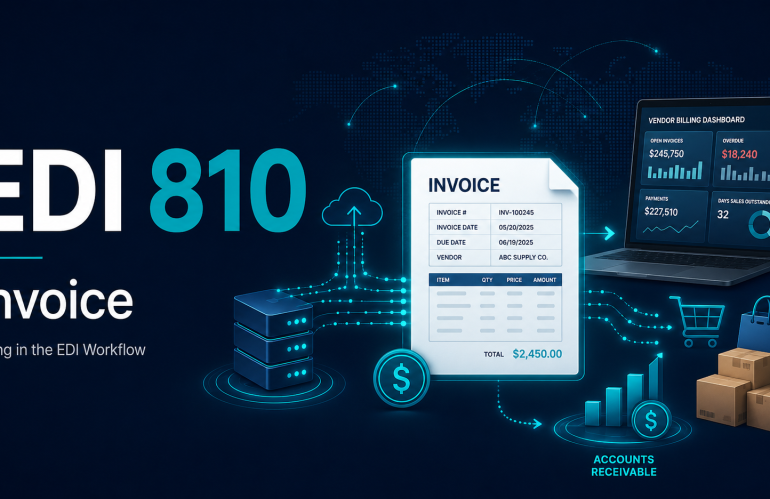
An EDI 810 is the X12 Invoice transaction set. A supplier uses it to send structured billing information to a buyer. For teams replacing emailed PDFs or keyed invoices, the 810 can make invoice data easier for the buyer’s systems to process—but only when both trading partners agree on the exact version, fields, identifiers, and validation rules.
What is an EDI 810 invoice?
The EDI 810 represents an invoice in a standardized machine-readable format. It can carry an invoice number and date, a purchase-order reference, party information, payment terms, line-item quantities and prices, and invoice totals. It sits on the billing side of an order-to-cash exchange: after an order has been accepted and goods have been shipped or services delivered, the seller sends the invoice so the buyer can review and pay it.
The transaction-set number identifies the business document, but it does not make every 810 interchangeable. The X12 version and the buyer’s implementation guide determine which elements are required, optional, or prohibited. A valid file for one retailer may fail another retailer’s rules.
Common EDI 810 segments
An 810 is organized into segments. The exact structure depends on the selected X12 version and trading-partner guide, but a basic X12 example illustrates several common building blocks:
- ST: starts the 810 transaction set and supplies its control number.
- BIG: identifies core invoice information, such as invoice date and number, and may include purchase-order references.
- N1, N3, and N4: identify a party and related address information when the implementation calls for them.
- ITD: communicates payment-term details.
- IT1: describes an invoice line, including values such as quantity, unit of measure, price, and product identifiers.
- TDS: communicates the invoice total. In X12’s basic example, the amount is expressed with an implied decimal, so implementation and testing must preserve the intended monetary value.
- CTT: can provide a transaction total, such as the number of line items.
- SE: closes the transaction set and provides a segment count and matching control number.
Do not treat this list as a universal implementation map. The implementation guide named in the trading-partner agreement is the controlling specification for that relationship.
How EDI 810 fits into order-to-cash
A common document flow starts with an EDI 850 purchase order. Depending on the relationship, the seller may return an acknowledgment and later send an EDI 856 advance ship notice. The EDI 810 then provides the billing document. The buyer can compare invoice references, lines, quantities, prices, terms, and totals with the purchase order and receiving records according to its own controls.
That comparison works only when identifiers remain consistent across documents. Purchase-order numbers, line numbers, product identifiers, units of measure, locations, and monetary amounts need agreed meanings. A syntactically readable invoice can still be rejected or held when those business references do not match expectations.
EDI 810 implementation checklist
- Confirm the standard version. Record the X12 release and exact partner guide.
- Map required references. Trace purchase-order, invoice, location, and item identifiers from the source system to the 810.
- Define amount handling. Test prices, allowances, charges, taxes, rounding, and implied decimals against known examples.
- Preserve line relationships. Confirm how invoice lines refer to purchase-order lines and what happens with partial shipments or invoices.
- Validate envelopes and control numbers. Transaction-set validation is only one part of a complete EDI interchange.
- Test acknowledgments and rejections. Define who monitors failures and how errors are corrected.
- Reconcile totals. Check line extensions and summary totals before transmission.
Frequent EDI 810 problems
Common implementation risks include using a product identifier the buyer does not recognize, omitting a required purchase-order reference, sending the wrong unit of measure, formatting an amount incorrectly, or applying a generic map where a partner-specific rule is required. Testing should include ordinary invoices plus realistic exceptions such as multiple lines, partial fulfillment, discounts, freight, tax, and corrected billing.
The key takeaway
The EDI 810 provides a standard vocabulary for invoice data, not a one-size-fits-all invoice template. Start with the applicable X12 version and the buyer’s implementation guide, then validate references and calculations across the full order-to-cash flow. If you are planning an ecommerce or order-system integration and want help defining a maintainable document workflow, contact us.